|
When today's writers
attempt to chronical Seattle's earliest breweries their most quoted
source is Baggley's HISTORY OF SEATTLE From the Earliest
Settlement to the Present Time Vol. II, pubished in 1916.
Here he discusses Seattle's brewing industry.
Unfortunately, Bagley's flawed account missed
a number of important details, and made a number of errors that
have been repeated over the years without question.
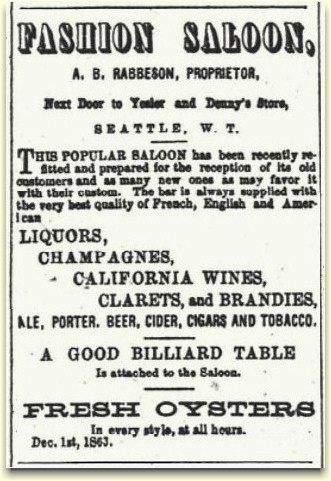
Antonio B. Rabbeson opened his Fashion Saloon in late 1863 after
refitting an existing saloon. It was situated at the foot of
Columbia St. next door to Yesler & Denny's dry goods store. In
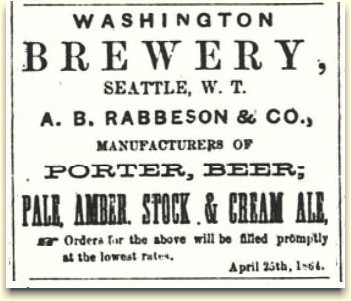
March of 1864 he added a brewing plant and named it the Washington
Brewery. Today we would refer to his saloon & brewery as a
microbrewery or brewpub.
At this time the city's population was less than 800 with lumber
the primary industry, and men outnumbered women 10 to 1. So there
were a good number of saloons for the thirsty lumbermen. Prior to
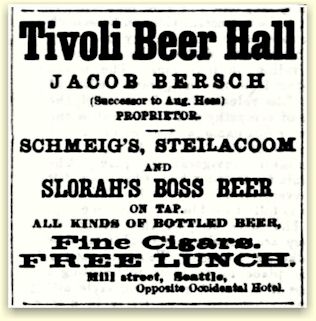
Rabbeson, the only source for local beer was Schmieg & Butterfield's
brewery in Steilacoom, or Frost & Fowler's Mukilteo Brewery. Beer
was also imported from California.
About the same time that Rabbeson's new brewery was in operation,
Samuel F. Coombs was selling his Union Store agency. Then on Sept.
1, 1864, Samuel F. Coombs purchased Rabbeson's brewery for $2,600.
He then moved the brewery to a different location, at
Mill & 4th Sts., and engaged an experinced brewer. However, he lasted just short of one year.
In Feb. 1865, Joseph Butterfield started
foreclosure proceedings on a mortgage for property he sold to
Coombs. This compromised Combs' financial situation,
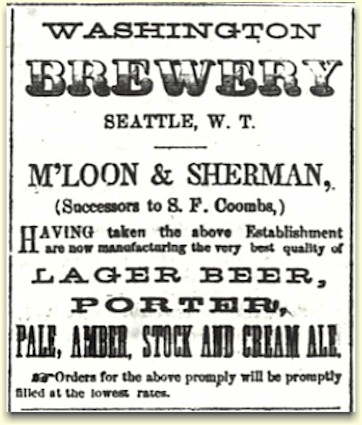
forcing the sale of the brewery. In July of 1865, a Seattle Gazette
ad indicated that S. F. Coombs had sold the Washington Brewery to
E.C. McLoon & Chris Sherman, facts missed in Bagley's history.
By 1866 the brewery had an output of about 500 barrels of beer per
year. A capacity determined from a tax record filed for the month of March
of that year.
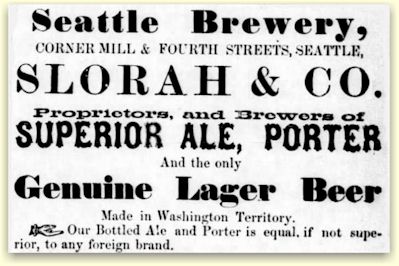
In August of 1871, Stuart Crichton & Co. purchased the Washington
Brewery, and renamed it the Seattle Brewery. He made some
improvements to the plant and soon had increased the annual output
to 635 barrels.
The Seattle Post-Intelligencer, on Feb. 17, 1877, reported
on their newly completed improvements, which included two additions
to their cellars, two new coolers, and a large brewing kettle with a 24 barrel
capacity. Two new vats with a capacity of 900 gallons each
have also been installed. A new malt House has also been
constructed, which relieved them of the necessity of importing
malt from San Francisco. They claim to have a large and growing
demand for their beer and have already made several large shipments
to California.
The following newspaper article was published on 16 Dec. 1883 in
the Seattle Post-Intelligencer:
Despite Bagley's assertion, King did not retire a number of years prior to Slorah selling
the Seattle Brewery, but rather remained Slorah's partner and even ran the brewery
alone just prior to its sale. The 1884 Seattle Directory named A. H. King as sole proprietor of the
Seattle Brewery at 4th & Mill, but Slorah still owned a majority
share in the brewery. With his North Pacific Brewery, near Lake
Union, now completed Slorah decided to sell the old brewery, and King,
wishing to retire, agreed. The Seattle Brewery was then sold to
Earnst Romey, a 26 year old who, along
with his young wife, had arrived in Seattle the previous
year.
In June of 1888, the 30 year old Romey suddenly died leaving his
young wife, Dorthea, owner of the brewery. She soon entered into a partnership
with a saloon operator named, Julius Wegert. It was this unlikely pair
of 24 year olds who approached Andrew Slorah, the previous owner, with a
proposition. As it happened, Slorah was looking for a change,
and was open to a deal. On Aug. 9th of '88, he sold
his Lake Union brewery for $6000, to Wegert and Romey.
The partners then closed the Seattle Brewery and dismantled it for their new venture, as
Bagely had speculated.
The following is
Bagley's flawed history of the North Pacific Brewery.
On 15 Sept. 1875,
Martin Schmieg's 34 year old wife, Agusta, died after a short
illness. Martin then asked Augusta's
brother-in-law, Ernst Picht, to assist him with his business. Picht
was an experienced brewer, having established the first brewery in
New Westminster, B.C., in 1860.
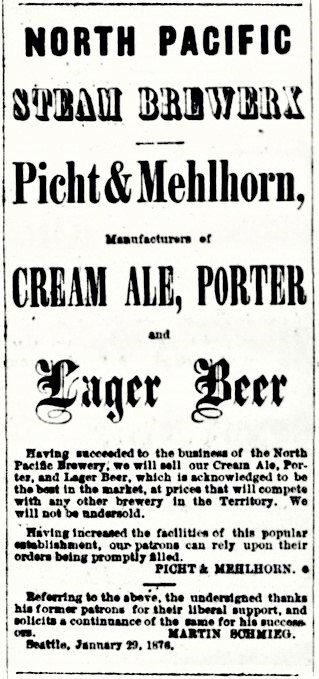
Picht, and his wife, Anna (Agusta's sister), agreed to purchase
one-third of the business from Schmieg, as did August Melhorn, a
Schmieg employee with an interest in the brewery.
According to Bagley, Schmieg turned the brewery over to Mehlhorn,
but that was not so. Actually, he gave power of attorney to Dexter Horton and C.C.
Perkins, and left the brewery in the hands of shareholders, Anna Picht and Mehlhorn.
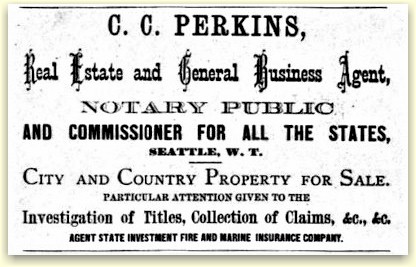
Dexter
Horton was an attorney, and C.C. Perkins, a general business agent.
However, Perkins was also an opportunist.
On Jan. 25, 1877, C.C. Perkins¹ married
the widow Picht.
The Perkins pair attemped to oust Mehlhorn, but unlike in Bagley's account,
Schmieg returned from Germany before that could happen. He arrived on May 11, 1878, and quickley
revoked the power of attorney for Horton and Perkins. Then on June
19th the Weekly Pacific Tribune reported:
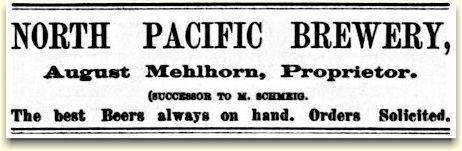
Mehlhorn then bacame the sole proprietor of the brewery, running it
sucessfully for the next three years, and increasing the brewery's
annual output to 2,000 barrels.
The brewery's ultimate demise was not as Bagley stated in his poorly
researched history. Rather than being dismanteled, as he claimed,
the brewery was totally destroyed by fire on
Dec. 16, 1882. Luckily the adjoining Fountain Beer Hall escaped
serious damage, and instead of rebuilding, Mehlhorn decided to quit
brewing and become a saloon keeper. He took over the business
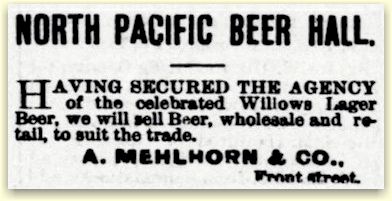
and renamed it the North Pacific Beer Hall. The Seattle Post-intelligencer
began running this ad in Januray 1883
.
After a 17 year run, Schmieg's historic North Pacific Brewery was
closed for good in Dec. 1882.
Slorah's North Pacific
Brewery
(1884-1896)
The following newspaper article was published on 16 Dec. 1883 in
the Seattle Post-Intelligencer:
Unfortunately, Andrew's enthusium about the business was to be
curtailed. Just four days after the above newspaper article
appeared, his wife, Sarah, died from a protracted illness.
As discussed in the previous section on the Seattle Brewery, Slorah
had sold the brewery to Ernst Romey, and when Romey suddenly died
his widow and Julius Wegert formed a partnership. Their plan was to
dismantle the Seattle Brewery and take over Slorah's new
brewery. On completition of this August 1888 sale,
Slorah took a trip to California and was
married there before the month was out.
The Seattle City Directory listed Wegert & Romey as poprietors of
the North Pacific Brewery, but that only lasted until Jan. 2, 1889,
when the partnership was disolved. Two days later, on Jan. 4th, a real estate
transaction was reported in the Seattle P-I whereby Dorthea
Romey transfered the brewery property to Julius Wegert
for one dollar, indicating that Romey didn't contribute real estate
to the partnership. Dorthea left Seattle for San Francisco, and
never remaried.
By 1888, the Seattle population had grown to 20,000, and the demand for
beer was greater than ever. A newspaper article published in Jan.
1889, discussed Seattle's industrial progress in the previous year
and mentioned the three Seattle breweries. Hemrich's Bay View
Brewery had the largest oputput with 6,000 barrels, with The North Pacific
Brewery coming in second with an output that had more than doubled
during '88 to nearly 2,000 barrels.
Edward Sweeney's brewery did a mear 1,500 barrels for the year.
The North Pacific Brewery continued operating for a little over five
year under the management of George Saake, previously a cooper. By late 1897,
the brewery was in the hands of Alvin Hemrich. A real estate
transaction was never reported, naming either Saake or Hemrich, so it
appears that John Hemrich, Sr. had purchased the property through
his agent in '91, and hired Saake to manage the brewery until his
son, Alvin, could take over.
Alvin operated the brewery
as the
Alvin
Hemrich Brewing Co. producing steam beer and porter.
Then in early
'98, Alvin was joined by his brother
Louis, and Julius Damus, in the organization of the Hemrich Brothers
Brewing Company, which was incorporated under the laws of the state on
the 4th of February, 1899.
FOOTNOTES: ¹
C.C. Perkins was a well known name in Seattle in the
1870s, however not even his closest friends knew what the "C. C." stood for.
The following is an incident recounted by Charles Prosch from
his Reminiscenses of Washington Territory, pub in 1904:
Having attained significant wealth, Schmieg returned to
Germany sometime after May of 1882, were he remained until his death in Sept.
1884 at the early age of 54.
Article by
For any comments, additions,
or corrections -
All contents including images are copyright by BreweryGems.com
|
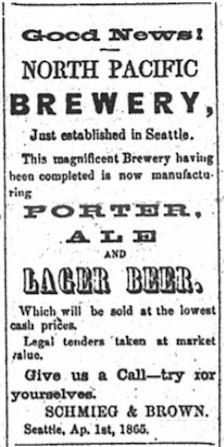 Butterfield did dispose of his share in the business
- quite soon!
On
Feb. 1, 1865 the Seattle Gazette published an ad announcing that
Butterfield & Co. are now offering Porter, Ale and Lager Beer. Then
just two months later this identical ad appeared, indicating Schmieg &
Brown were now the propritors instead of Butterfield & Co.
However, Bagley's account is mostly in error. Rather than
"a little later," Brown remained with Schmieg for an additional nine
years, leaving him a sole propritor in 1874. By this time the
brewery had an annual output of 1,245 barrels.